
Agile Vacation Planning
Since this is my blog post, I get to write about whatever I like. So, if you’re still going to invest your time reading this, well, you’re going to endure me sharing a little bit of my family vacation. I should really add some family vacation photos to this post.
I’m typing this on Wednesday night, while sitting under the stars, listening to the ocean waves gently roll onto the beach as the tide slowly begins its advance on the shore. It’s a little after midnight at the Bay of Fundy in New Brunswick, and my family is fast asleep in our tent after a drive across Confederation Bridge earlier this evening, from PEI.
If you’ve not seen Confederation Bridge, it truly is an engineering marvel. At least to a layman, like me. Maybe if you’re an engineer, it’s less impressive. But I doubt it.
Today, we visited the house of Anne of Green Gables, and spent a great amount of time on Cavendish Beach.
It certainly doesn’t strike me as any surprise, but others may find it odd that our vacation is planned following many of the Agile principles and values, and follows many of the frameworks that are out there.
See what I did just there? I segued seamlessly from my family vacation to a post about Agile. I’m so clever.
My wife does most of the vacation planning. It’s a passion of hers. I think, in another life, she would be an event planner like no other. But in this life, I get her vacation planning all to myself. When she & I first started dating, she liked to plan every detail. She’d have every stop planned, every attraction lined up, every hotel or campsite booked. The problem was, as we’d be driving along a road, we’d see a gift shop, an attraction, a winery, or something, and would pique our interest. But there was no slack in her plan; stopping at that unexpected wonder would mean we’d be late for whatever she had planned next.
This was never how I planned a trip. And it’s no longer how my wife plans trips.
For our trip this year, we wanted to take our kids to Eastern Canada. We wanted to see the Cabot Trail, Bay of Fundy, all of PEI, L’Anse aux Meadows… Well, all of Eastern Canada, to be honest.
But we have limited vacation time, and limited money. So, we had to cut back on a few things. We decided that the Bay of Fundy would be our target destination. But, we’d see some things on the way there, and on the way back. The planning evolved from identifying our destination, and then coming up with a plan on how we’d get here. We decided on driving out here via Sherbrooke. But a few days before our trip, we realized we could adjust our route to go via Stowe, somewhere she’s always wanted to see, and then come up through Maine. And as we looked at that route, we noticed that with only a little additional variation, we could fit in a day at Bar Harbor, and a quick Puffin & Whale Boat Tour. We also had a list of other things we’d like to do in the area, but we didn’t book any of them – in fact, we only booked the Puffin tour the day before we were to leave. And you may be wondering, why didn’t we book one of those other things, and why’d we leave booking the tour so late?
I like to think of the tour booking as the last responsible moment. We wanted to make sure that was the route we were going to take. We wanted to factor in the latest weather updates. Out of the myriad of things we could do, we wanted to leave our options open. But, with the weather looking good, we booked it.
And with everything else we had available to us? We wanted to make a decision based on how our kids were doing, and with the local information available to us when we reached Bar Harbor. Believe me, there is no shortage of things to do in Bar Harbor! But, with our limited time, and our limited budget, we deferred our decision until we had as much information as possible. We ended up taking an amazing 2.5 hour trolley tour through Acadia National Park in the afternoon. Both my wife and I commented that we could have spent our entire vacation in Bar Harbor. But we had one day. And we made the most of it.
Part of any vacation is saying no to things. It’s the hardest thing to do. Right now, we’re in New Brunswick, and we’d love to spend time exploring the Cabot Trail in Nova Scotia… I’ve been out east a number of times; this is my wife’s first time. And I’ve seen a lot out here. But that’s one thing I’ve missed every time.
Planning a vacation, like planning anything, is about saying no. It’s the hardest thing to do. It’s easy to say yes to things, and try to squeeze everything possible into the time and budget available. But the quality, and the time to enjoy what it is that you’re doing gets overshadowed by the urgency to check it off, and get on to the next thing. And there’s no time, or money, when something unexpected is discovered. Not everything can be found in a travel brochure; often the best things don’t show up on the first page of a Google search. You only discover them by going on the journey.
Our trip to PEI today wasn’t really planned. We woke up this morning, and just decided it was the thing that we wanted to do. The consequence of this is that our kids aren’t going to see Magnetic Hill. They’re not going to spend time in downtown Moncton. They’re not going to miss out on another hike through Fundy Park (which they both love). Going on a vacation is about saying no.
One of the Agile Values is that “we value responding to change over following a plan”. My wife and I: we have a plan. Our plan is to expose our kids (and ourselves) to as much Eastern North America as possible this summer. We believe that exploring and learning about others enriches and improves our own appreciation for the world around us. This means that our plan brought us to the Bay of Fundy via Vermont, New Hampshire, and Maine. And will take us home via Fredericton, Edmundston, and Québec City. That’s our plan. The details of which we’ll continue to work out as we go. We had a destination, and we’re here in Fundy National Park. And we’ve researched lots of options, and are continually being exposed to more options we’d not considered ahead of time. Allowing us to make the best decision in the moment, based on the most accurate feedback.
If you’re still reading, get ready for one more family story. Seriously. This is way too long. You might want to think about getting back to work. But this is what happens when I’m sitting under the stars in an amazing National Park with my laptop open.
My son loves to try new food. We were in Alaska a couple of years ago, and he tried a few different types of crab. He loved it. Fresh crab. He tried some other stuff too, but that’s not important for this story. We wanted to give him the chance to try lobster, being on the east coast of North America! So, in Bar Harbor, on our second night, he tried a lobster roll. He did enjoy it. So the next night, he had a full lobster dinner, which included him having to pull it apart himself to get to the meat.
It doesn’t get more Agile than that… Try a safe experiment first – a lobster roll. It’s a familiar format (a sandwich format, more or less). And only then did we splurge on the “market price” full lobster dinner. Had he not liked the roll, I’d have been less willing to invest in a lobster dinner for him.
So far, we’d happily spend a week – or more – in every place we’ve seen. And we’re going to continue making decisions based on the best information we can get, at the last responsible moment. The next time someone tells you Agile is only for software development, tell them that you know someone who applies the principles and values for a family vacation.
Lean Coaching Summit
It all begins with an idea.
Last week, I had the opportunity to attend the Lean Coaching Summit, an event put on by the Lean Enterprise Institute.
It was a good couple of days, with lots of information, sharing of ideas, and collaboration. I took away a number of ideas and thoughts from the various sessions. But the conference started with a Lean Coffee session. I’m a huge fan of the format of Lean Coffee, because the topics discussed come from the people participating, and are voted on by the group, so the highest priority topic gets talked about first. In a matter of moments, our table of seven people had generated over 30 topics we’d like to discuss. But after a quick vote, two topics clearly came to the top, so we started on the first one, and when done with it, moved on to the second. At the same time, all the other participants at the conference were doing the same thing, at their own tables. And at the end of an hour of discussion, folks shared what their insights were, and shared them for all to see.
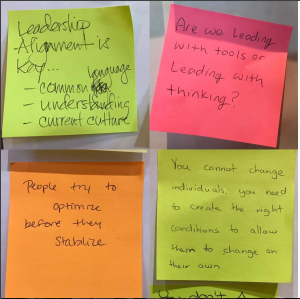
As I walked around the room, looking at the insights gathered, four jumped out at me, from four different tables. And while this was a Lean summit, you’ll notice that none of the ones that really resonated with me have to do with Lean or Agile specifically. Let me touch on each of these, briefly, to explain why they resonated with me.
Leadership alignment is key…
Common language
Understanding
Current culture
Alignment is key. Having a common language allows us to communicate effectively, not just with our leaders, but with each of us. But words are not enough. We also need to have a shared understanding of what those words mean. The same word(s) can have different meanings to different people. Communication, and language, depends on both the sender and the receiver (and also the medium used to communicate – I’ve read about that somewhere…). I think most companies feel like they’ve got a lot of good stuff going on in this space. I’d encourage you to challenge that assumption, and find a way to validate it’s true. And even if you think it’s good, I suspect it’s not perfect, so where can we look at our current understanding and culture, and think about what the next improvement could be.
Are we leading with tools or leading with thinking?
One of the core principles from Agile is that we value Individuals and Interactions over Processes and Tools. It’s important that we remember that Agile values both Individuals & Interactions AND Processes & Tools. Know how I know? It’s because that’s what’s written in the Agile Manifesto itself. So while there’s value in both, if we just blindly use a tool, we’re unlikely going to get much value from that tool. Take your daily stand-up, for example. If you’re not getting value from it, or aren’t sure why you’re doing it, you may have perfectly implemented the tool, without understanding the why. Tools are great to help support and push our thinking forward, but on their own, they can become ‘check-the-box’ activities, that don’t actually help us deliver a better solution to our customers. We need both, tools and thinking.
People try to optimize before they stabilize
Wow. This one really hit home for me. I’ve seen this time and time again, when we want to jump straight to (what we think is the) end state. Thinking back to the last point, tools or thinking, the reality is that it’s the journey we’re on that’s going to make sustainable, meaningful change. I worked with one manager who was great at getting short term results. He jumped directly to optimizing when working with a new team. The result, though, was that the team was full of disfunction, a severe lack of trust, and as a result, the inability to sustain the short-term performance gains the team produced. Effectively, they skipped all the hard work in changing the way the team & stakeholders thought about delivering value, and really, about building a team in the first place. This also ties back to the first post-it, about starting from a place with a common understanding of the current culture and understanding of where we are today, and what the next step could be. While we want to have an idea of the direction where we want to head, it’s going through the process and learning along the way that creates a sustainable culture and environment.
You cannot change individuals, you need to create the right conditions to allow them to change on their own.
What can I say about this? I can help with all of the tools and processes. I can tell you exactly what to do. But that’s not going to help on any Lean and/or Agile journey. No matter what I say, or what I do, it’s not going to change you. Only you can change you. Only I can change me. And it’s through learning what works that we make those changes. Now certainly, a Lean Change Agent, Lean Coach, or Agile Coach can hopefully bring some experience and expertise that can help accelerate, and be a guide on your journey. They can help play Devil’s Advocate, and offer alternative approaches to how things are currently being done. But ultimately, it’s up to each of us to set the conditions for ourselves, and for those around us, to change so that we can deliver more value.
If we continue doing things the way we always have, we’ll continue to get the results we always have. It takes new thinking, and new approaches to arrive at new solutions. But just as in the previous section, it’s about each of us going on that journey so that it’s sustainable. This isn’t about delivering great work in the next quarter, or next year. It’s about creating an environment where great work is inevitable.
There were lots of great ideas discussed at the conference. These are just four that resonated with me from the first breakout session of the conference! I hope you’re thinking about your own work, and what you can do to challenge how work gets done today, how you can help create an amazing environment to effortlessly get work done, and how can we propagate that information in helping create the right conditions to win as a team.
Agile Change
If you fail to change the way you look at the way you do your work today, all of the stickies in the world aren’t going to help you.