
Escalators & Flow
As I was working at an organization that was looking to improve their outcomes, we looked at the benefits that a solid, accurate, visual management board might offer. The idea is to make transparent all of the work that’s being done, or being considered. Some of this work was repetitive, business-as-usual, keep-the-lights-on sort of work; some was new projects; some of it were minor (and sometimes not-so-minor) enhancements; and some of it was ad hoc work, seemingly to come out of nowhere. And some of it was “urgent” work that required us to stop our current in-progress work in order to address this emergent, unplanned, urgent work.
We were able to represent it all. But why?
Great question. We wanted to understand how work flows through our teams, from the moment it hits our backlog, to the moment we deliver it to our customer and receive a return on our efforts. Most of our work was invisible (and by this I mean that it’s not like an assembly plant or factory where we have physical things that we can see). Most of the work done in software development, user experience and user research, and data science work is work we can’t see. So visual management is one way to see, measure, and improve our system.
There will be things we can do in our teams to help improve our flow of work. And there will also be things that we can’t do – they’re outside what we can control. This is where we need to rely on our managers and leaders to fix our system. Through regular Retrospectives (one of the key aspects to finding improvements) or conducting an effective Study step in a PDSA cycle, we’ll likely start by finding easy experiments for us to try as a team to find improvements and ways of working better together. It’s likely that it won’t be long before the big rocks in our way are outside of the team’s control.
Take escalators, for example. The conventional wisdom is that we stand on the right, and walk on the left. I say conventional wisdom because it turns out that there might be a better alternative. If you visit Hong Kong, you’ll see folks standing on both the right and the left sides of the escalator.
Ludicrous, you likely think. But maybe not…
The theory, if counterintuitive, is also pretty compelling. Think about it. It’s all very well keeping one side of the escalator clear for people in a rush. But a 2002 study of escalator capacity on the Underground found only 40% would even contemplate it walking up the escalator. This effectively halves the capacity of the escalator in question, and creates significantly more crowding below, slowing everyone down. When you allow for the typical demands for a halo of personal space that persist in even the most disinhibited of commuters – a phenomenon described by crowd control guru Dr John J Fruin as “the human ellipse”, which means that they are largely unwilling to stand with someone directly adjacent to them or on the first step in front or behind - the theoretical capacity of the escalator halves again. Surely it was worth trying to haul back a bit of that wasted space.
So, at Holborn station, after seeing how the Hong Kong system worked, they tried an experiment at this one stop, for just three weeks.
And what happened? Well, flow improved during the experiment. They were able to move an extra 31 people per minute, and overall everyone got up faster. Not everyone was happy about change, and after the experiment things went back to the way they were. But flow was improved for everyone.
Yes, a couple of people - those who wanted to walk - got up slightly slower. But when everyone gets where they wanted to get faster, and more than 30 people per minute? We’re not talking about small impacts with a very simple (yet very counterintuitive) change. Understanding the system (the escalator) and then how work flows through it (the people)… It doesn’t take much to envision a possible solution.
What might a future flow improvement experiment look like? How about having a staircase next to the escalator for the smaller percentage of folks that are willing to climb a steep staircase?
I originally wrote this when I was working at a building in North York. This building has an escalator which was frequently under some kind of repair, which and there isn’t a staircase anywhere in the area! Yet, there’s all sorts of space between the two narrow moving staircases (one up, one down), where a perfectly good, regular staircase should be. It was a regular occurrence to have a crowded mess caused by a high volume of people all trying to go up and down using the single stopped escalator – narrow and with too-tall steps
Let’s bring that back to the flow of work in our teams and our organization. We have the ability to change how work flows through our system, getting from our backlog to done (standing on the left & right sides of the escalator). Exceptions to our regular workflow cadence may give the illusion of speeding things up, but only that one thing, and often at the expense of everything else. Building a staircase (for expedited items that genuinely need our immediate focus to get through our system)? That sounds like it might be something we need to enlist the help of our managers – it’s outside of our system that we control, but impacting the flow of our work. And, when urgent or expedited work emerges, an interesting couple of questions to consider… Is this work so important it should cause us to stop and delay our existing in-progress work? What’s the impact of that on our existing commitment? And, what can be done so we’re never blindsided by this sort of expedited work in the future, so we can have a solid flow of delivery? It’s important to note that a good Visual Management system won’t tell you what to do improve the flow of your system. But it should show you where things aren’t flowing for some reason. It’s then up to you to figure out what, if anything, you want to do about it!
Tracking all our work through a visual management board can help make the flow of all our work visible, and help us understand where we can make enhancements to getting our work done.
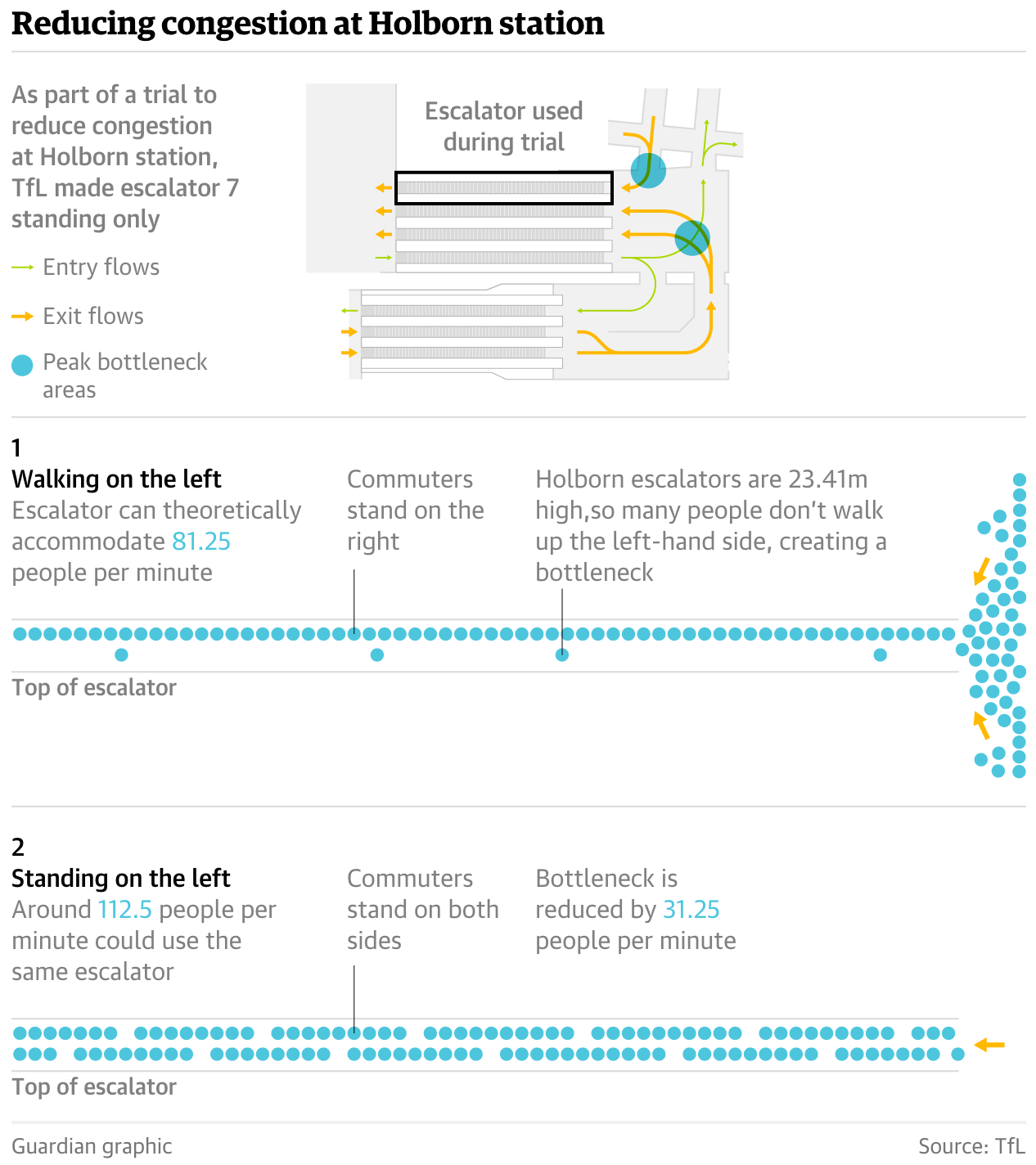
The full article I’ve heavily borrowed from, including the graphics, can be found here:
http://www.theguardian.com/uk-news/2016/jan/16/the-tube-at-a-standstill-why-tfl-stopped-people-walking-up-the-escalators
This was too good not to share. But I’ve tried to reduce the length as the original article is pretty long.